


Inflation and economic growth do not always move in the same direction. Sometimes prices rise even as hiring slows and household budgets become more strained. That combination presents a difficult challenge for the Federal Reserve—and an important consideration for investors.
Today’s inflation report illustrates that tension. September’s Consumer Price Index rose 3.7% over the past year, up from 3.4% in August. Core inflation, which excludes food and energy, increased 2.6% annually, compared with 2.4% the previous month. Gasoline accounted for more than half of September’s monthly increase in overall prices.
Meanwhile, the labor market has softened. Employers added 29,000 jobs in September, and annual wage growth was 3.0%. With headline inflation running above wage growth, households face renewed pressure on purchasing power.
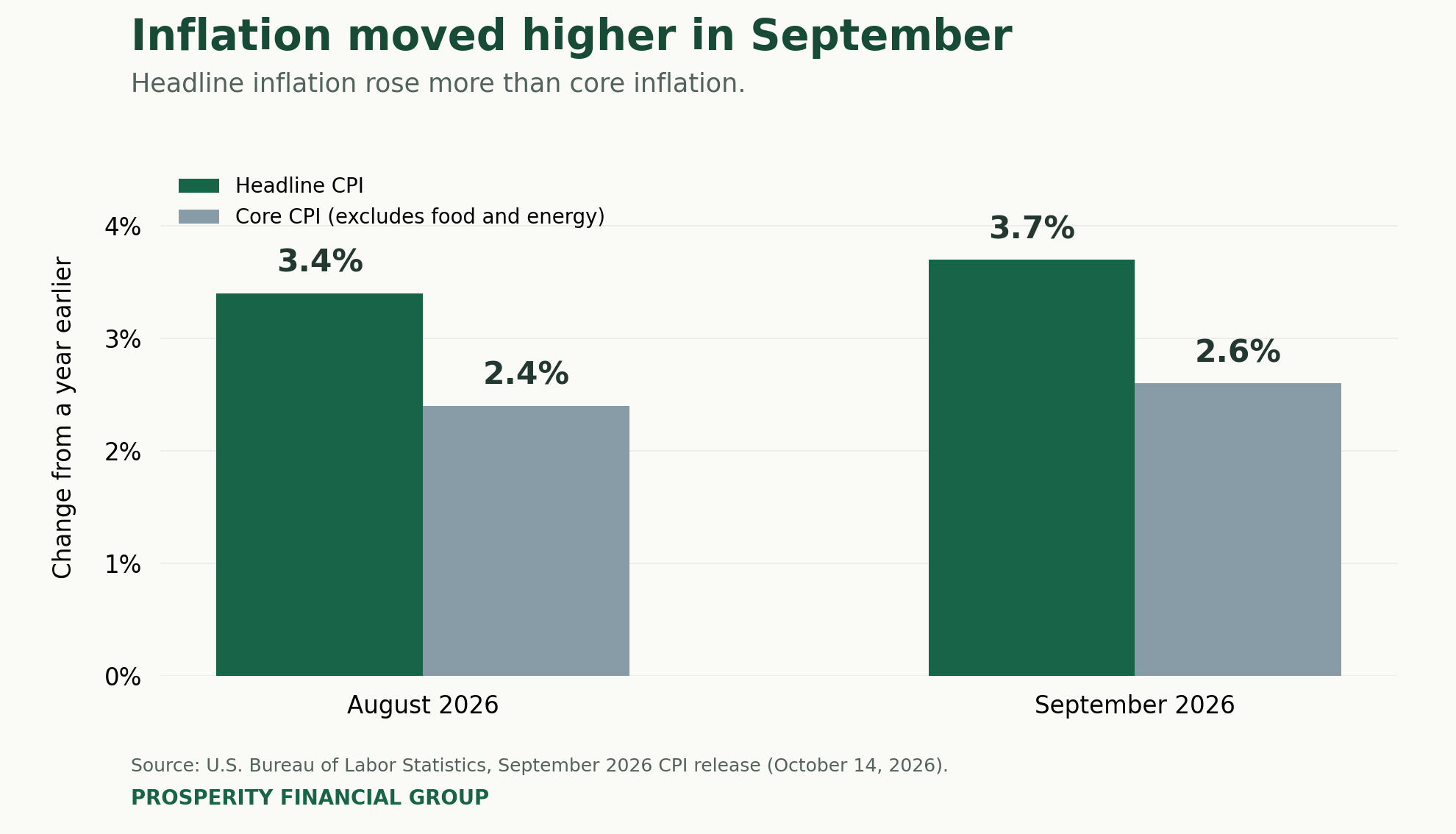
Source: U.S. Bureau of Labor Statistics, September 2026 CPI release, published October 14, 2026. Figures represent year-over-year changes.
Why this is a difficult problem for the Fed
Higher interest rates can slow borrowing and spending. They cannot directly resolve disruptions to energy supplies.
Nevertheless, the Fed must consider whether higher energy costs will spread into transportation, goods, services, and inflation expectations. If that happens, a temporary supply disruption can become a more persistent inflation problem.
The challenge is balancing that risk against an economy already showing signs of slower hiring. Keeping policy restrictive may help contain inflation, but it can also place additional pressure on consumers and businesses.
What this means for bonds
This environment reinforces the importance of distinguishing between interest-rate risk and credit risk.
Shorter-duration, high-quality bonds can provide income while limiting sensitivity to further increases in yields. When attractive income is available from stronger borrowers, investors should carefully evaluate whether additional credit risk offers sufficient compensation.
Some intermediate-term Treasury exposure can also serve a purpose. If growth deteriorates and yields decline, those bonds may provide valuable diversification. Inflation-protected bonds offer another way to address inflation risk, although their market prices can still fluctuate.
The objective is to balance dependable income with protection across several possible outcomes.
What this means for stocks
For equities, financial strength and valuation deserve particular attention.
Companies with manageable debt, consistent cash flow, and the ability to maintain margins may be better equipped to navigate higher financing costs and slower demand. Reasonable valuations also leave more room for earnings to fall short of expectations.
Sector exposure matters as well. Healthcare and consumer staples can offer resilience when household spending weakens. Energy producers may benefit from elevated commodity prices, although those benefits can reverse if supplies normalize.
Profitable growth companies remain relevant, too. A diversified portfolio can retain growth opportunities while reducing dependence on any single sector or economic forecast.
Positioning for uncertainty
Several paths remain possible: energy prices could ease, inflation could persist, or weaker demand could become the dominant concern.
At Prosperity Financial Group, we believe portfolio decisions should account for that range of outcomes. That means examining bond quality and duration, equity valuations, and the exposures already embedded across a portfolio.
A single economic report rarely calls for a wholesale change in strategy. It can, however, provide a useful reason to review whether a portfolio remains aligned with its purpose and the investor’s long-term plan.
Sources: U.S. Bureau of Labor Statistics, September 2026 Consumer Price Index and Employment Situation releases.
This commentary is for informational purposes and is not a recommendation to buy or sell any security. Investing involves risk, including possible loss of principal. Diversification does not guarantee a profit or protect against loss.